


Artificial intelligence is no longer a distant possibility; it's a defining force in today's workplace. As we move through 2025, the reality is nuanced - AI is transforming jobs, skills, and economies, and while some roles are at risk, new opportunities are emerging at an unprecedented pace.
AI’s Dual Impact: Job Displacement and Creation
AI is automating routine and repetitive tasks across sectors. According to the World Economic Forum, up to 85 million jobs could be displaced by 2025, with manufacturing and retail being especially affected. For example, it is predicted that two million manufacturing jobs will be replaced, and as much as 65% of retail roles could be automated as companies streamline their costs and processes.
However, AI is also a powerful driver of job creation. The same World Economic Forum report predicts 97 million new jobs will emerge, particularly in fields that leverage AI for efficiency, problem-solving, and innovation. Sectors like construction, agriculture, health care, data analysis, and AI-related engineering are experiencing significant growth as AI augments labor shortages and introduces new capabilities.
Most at Risk vs. Most Resilient Jobs
Jobs with High Automation Risk
- Data entry clerks, administrative support
- Basic customer service representatives
- Entry-level coding and content writing roles
- Retail cashiers and fulfillment staff
These positions feature highly repetitive tasks and have seen rapid automation, with companies reporting workforce reductions and a shift in entry-level roles.
Jobs Resistant to AI
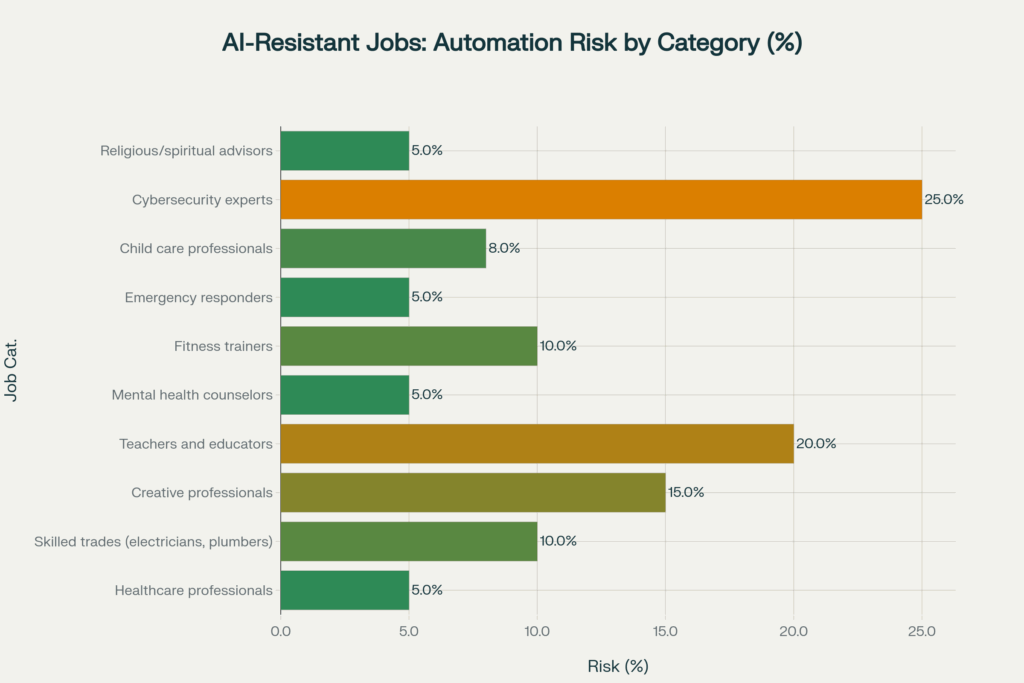
Healthcare professionals, skilled tradespeople, teachers, and creative professionals show the lowest automation risk. These roles leverage uniquely human capabilities that complement rather than compete with AI technology.
Roles demanding creativity, social intelligence, judgment, and adaptability remain in high demand because AI cannot fully replicate human insight or interpersonal skills.
The Most In-Demand Skills for the AI Era
AI is shifting the skill landscape. Employers are seeking talent in areas where humans excel, such as:
- Critical thinking & problem-solving
- AI & big data literacy
- Programming and math skills
- Communication, creativity, and leadership
- Adaptability and resilience
Analytical skills, adaptability, and emotional intelligence are becoming core job requirements, alongside technical capabilities like prompt engineering, AI development, and ethical oversight.
Industry Transformations Through AI
AI is not affecting all industries equally
| Industry | AI Impact | Example Changes |
|---|---|---|
| Manufacturing | High automation, predictive maintenance | Robot operation, process optimization |
| Retail | Inventory management, personalization | AI-driven shopping experiences |
| Healthcare | Diagnostics, personalized medicine | Early disease detection, treatment plans |
| Agriculture | Precision farming, yield prediction | Data-driven crop management |
| Design & Media | New AI-powered creative tools | Enhanced content creation, AI design roles |
Manufacturing and retail see routine jobs displaced, but demand grows for systems managers and AI-augmented roles. Health care and agriculture benefit from AI’s analytic power, boosting productivity and demand for specialized skill sets.
Economic Impact and Job Statistics
- AI-driven automation is expected to grow the global automation market to $226–227billion in 2025, with Asia-Pacific leading the charge.
- Studies estimate a net gain of 12 million jobs globally by 2025 as tech-driven roles offset declines in routine labor.
- In India alone, almost 400,000 new AI jobs could be created by 2025 as businesses invest in digital talent and solutions.
- Firms that integrate AI tools report a 22% average reduction in operating costs, as well as noted boosts in team productivity.
Chart: Job Displacement vs. Creation (2025, Worldwide)
| Jobs Displaced | Jobs Created | |
|---|---|---|
| 2025 Estimate | 85million | 97million |
Preparing for the AI-Powered Future
For Individuals
- Invest in lifelong learning, especially AI, data skills, and human-centric abilities.
- Embrace collaboration with AI tools to enhance rather than compete with machine intelligence.
- Cultivate resilience and adaptability to changing job demands.
For Companies
- Develop reskilling and upskilling programs.
- Adopt hybrid (human + AI) workflows.
- Foster a culture of innovation and responsible AI use.
For Policymakers
- Support educational reforms emphasizing digital literacy and human skills.
- Design social safety nets and workforce transition policies.
Human Advantage: What AI Can’t Replace
Despite its transformative power, AI can’t replicate empathy, ethical reasoning, creative thought, or complex physical skills. Human qualities like emotional intelligence and ingenuity remain irreplaceable, and jobs that nurture these strengths are set to thrive.
Conclusion
Will AI replace your job? For some roles, yes. For most, the future is one of transformation and collaboration. Those who nurture uniquely human skills and embrace continued learning will seize the many opportunities the AI age brings.
The question isn't whether AI will change the future of work but how we all choose to adapt, upskill, and shape a world where human potential and AI innovation grow together.
If you’re interested in exploring more stories, data, and real-world examples about how AI is shaping the workforce, be sure to check out the full series covering workplace transformations, skill-building resources, and the latest trends driving change in modern careers.